Blog
Geometric Jewelry: Edgy Meets Elegant


Geometric jewelry pairs crisp lines and clear shapes with traditional jewelry techniques. The result is pieces that feel modern and a little edgy, yet remain wearable and refined. This guide explains how designers and buyers balance proportion, materials, gemstones, and construction so geometric pieces look elegant rather than harsh. I’ll give practical measurements, alloy notes, setting choices, and care advice so you can judge or design geometric jewelry with confidence.
Shapes, scale, and proportion
Geometric jewelry is built from simple forms: triangles, hexagons, circles, bars, and polygons. The way you size those shapes determines whether a piece reads as edgy or elegant.
- Small, delicate pieces: studs or pendants from 6–12 mm across feel refined. Example: a 7 mm hexagon stud with a 0.05–0.10 ct accent diamond in a flush setting reads understated.
- Wearable statement pieces: collar necklaces or rings 25–60 mm across command attention without appearing heavy. Example: a 40 mm open-work pendant with 1–2 mm bands keeps air and lightness.
- Proportion rules: keep line widths at about 6–12% of the overall dimension for elegance. For a 30 mm pendant, a band width of 2–3.5 mm works well.
- Balance edges with curves: soften sharp vertices by rounding them slightly (radius 0.3–1 mm). That keeps the geometric intent but reduces the “harsh” feel.
Material choices and metal specifics
Metal choice changes a design’s mood and durability. Be specific about alloys and thickness for long-term performance.
- 14k gold (58.3% Au) is a good balance of hardness and color stability. Use for daily-wear geometric rings and bracelets. Typical shank thickness: 1.8–2.5 mm.
- 18k gold (75% Au) has richer color but is softer. Reserve for fine necklaces and earrings where prongs and bezels are thinner (0.9–1.2 mm walls).
- White gold is usually rhodium-plated. Expect re-plating every 1–3 years depending on wear. Use for sharp-edged designs that need bright white contrast.
- Sterling silver (925) is affordable and easy to finish (matte or mirror). For geometric work, keep plate thickness >= 0.9 mm to avoid warping.
- Titanium and stainless steel suit industrial, edgy looks. Titanium is hypoallergenic and very strong—good for thin, long bars and cuffs.
Gemstones: cuts, carat sizes, and setting logic
Gemstone shape and setting affect both aesthetic and durability. Geometric settings often favor clean-edge cuts.
- Recommended cuts: trillion and princess cuts fit triangles and squares. Baguette and emerald cuts suit linear channels. Rose-cut and hexagonal rose cuts work for flat, matte looks.
- Carat and visual impact: a 0.50 ct round brilliant is about 5.0–5.2 mm and reads substantial in a 10–14 mm geometric motif. Small accents 0.01–0.05 ct (1.3–2.8 mm) add sparkle without softening the geometry.
- Durability: diamond (Mohs 10) and sapphire (Mohs 9) are ideal for pointed shapes (marquise, trillion) because they resist chipping. Avoid using emeralds or opals in thin bezels or exposed points; their Mohs hardness (green emeralds 7–7.5, opal 5.5–6.5) and internal inclusions make them fracture-prone.
- Clarity/cut notes: for pavé or micro-set accents, SI1–SI2 clarity is acceptable because small stones hide inclusions. For a visible center stone in a minimalist geometric setting, aim for VS2–SI1 to keep the eye on clean lines.
Settings and construction details
Choice of setting changes both style and longevity. Geometric designs need precise tolerances.
- Bezel settings reinforce edges and accent geometry. Recommended wall thickness: 1.0–1.5 mm for durability. Bezel works well for daily-wear studs and pendants.
- Channel and bar settings create clean linear rows. Channel widths must match stone girdle width within ±0.05 mm to avoid movement. For 2.5 mm baguettes, allow a channel internal width of ~2.6 mm including clearance.
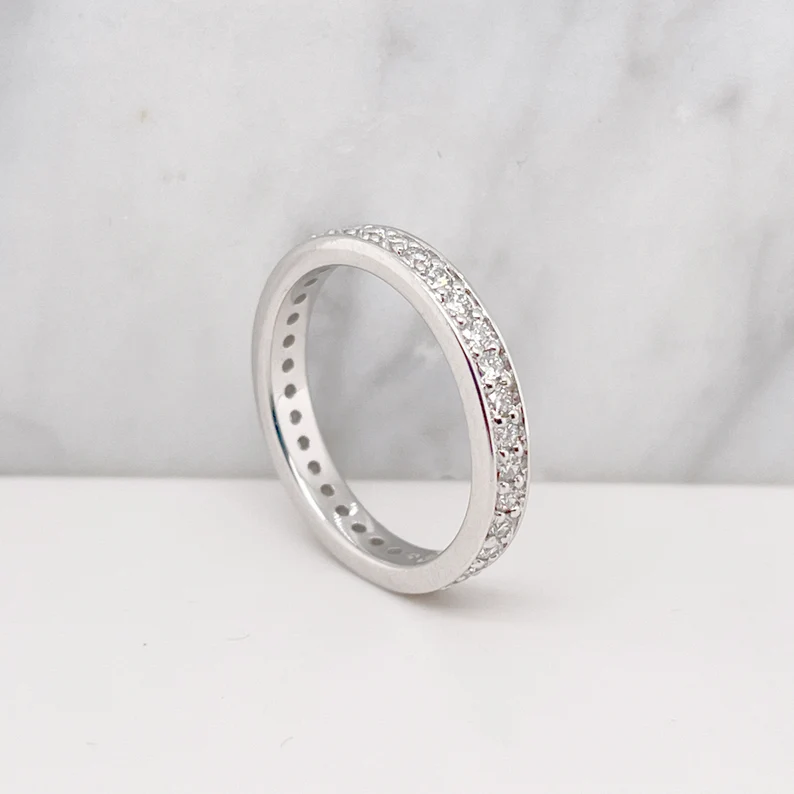
- Pavé and micro-pavé give sparkle along edges. Require consistent bead heights—tolerance ±0.1 mm. Bead thickness should be at least 0.6–0.8 mm to hold stones securely.
- Prong settings maximize light but need maintenance. For geometric pieces with sharp angles, use low-profile prongs (1.2–1.5 mm) to prevent snags.
- Manufacturing: CAD/CAM milling plus laser welding achieves sharp, repeatable geometry. Hand finishing—diamond-point polishing, bead-blasting, or satin brushing—adds the human touch that reads elegant rather than mechanical.
Comfort, wearability, and hardware
Edgy design shouldn’t compromise comfort. Small details matter.
- Ring shanks: use a comfort-fit inner radius of 1.0–1.5 mm when edges are square on the outside. Shank widths of 2.5–3.5 mm suit most fingers for stability.
- Earrings: posts at 0.8–1.0 mm gauge with friction or locking backs reduce rotation and maintain orientation for geometric faces.
- Pendants and bails: open bails of 3.0–4.5 mm internal height accommodate chain gauges from 0.7–1.5 mm. For heavier geometric pendants, use a hidden bail that distributes weight evenly.
Styling and mixing metals
Geometric pieces layer well. Keep contrasts simple and deliberate.
- Pair a sharp, matte hexagon cuff with a thin polished circle pendant to soften the look. Contrast creates focus.
- Mix metals by repeating a single motif in different alloys—like three stackable bars: 14k rose gold, 14k yellow gold, and rhodium-plated white gold. This maintains cohesion while using contrast.
- Negative space: openwork and cut-outs reduce visual weight and keep large geometric pieces elegant.
Care and maintenance
Geometric details need inspection and occasional servicing.
- Check bezels, prongs, and pavé beads every 6–12 months. Tiny shifts in bead height or 0.1–0.2 mm movement can lead to loss.
- Rhodium-plated white gold will need re-plating to restore color, typically every 1–3 years depending on wear.
- Avoid ultrasonic cleaning for fragile stones (pearls, opals, emeralds) and inlay work. Use warm water, mild soap, and a soft brush for most geometric pieces.
By considering scale, alloy, gemstone choice, and setting tolerances, geometric jewelry achieves that balance of edgy and elegant. Small technical decisions—mm of bezel wall, carat size, clarity grade—determine whether a piece remains refined over years of wear. Keep measurements and materials in mind when buying or designing, and the result will be modern, wearable, and lasting.